
The Harder family story
From Europe to a Kansas Farm
Mennonite roots, a 17-day ocean crossing, and generations of work near Whitewater.
European roots
Farmers in the Vistula Delta
The family’s forefathers were farmers from the Flanders region in the Netherlands. Mennonite farmers later settled in the Vistula Delta in northern Poland, where their experience with dikes and canals helped turn low, wet ground into productive farmland.
The region later came under Prussian rule, and the Mennonites began speaking German. That is why the family’s background may be described as Dutch, German, Prussian, or Polish; the names point to the same small part of Europe at different moments in its history.
Mennonites had moved there to escape persecution and because they had been promised exemption from military service. When taxes and military pressure increased, many families began considering Canada and the United States.
Born 1811
Bernhard Harder Sr.
Bernhard Harder Sr. was born in West Prussia in 1811. After losing his parents, he was raised by his grandparents and later lived with an uncle. Restrictions on Mennonite land ownership left him without a farm of his own, so he worked as a hired hand for Anna Regier, whom he later married. After Anna’s death, Bernhard married Agatha Regier and had two sons, and later married Justine Bergman, with whom he had another son.
Bernhard was known as an expert gardener. Guided by faith and conscience—and wanting opportunity for his sons as they approached military draft age—he sold the farm and garden he had tended for 44 years. After investigating Russia and finding no dependable military exemption, the family chose America.
Bernhard, Justine, and the three sons crossed the Atlantic, entered through New York, and eventually settled in Butler County, Kansas, where their group purchased six sections of land. They faced unfamiliar farming methods and few modern conveniences, but they were grateful for the opportunities of their new home.
1854–1940
John Harder Sr.
John Harder Sr. was born in 1854 in the Danzig area of northern Poland, then known as West Prussia. He married Marie Regier on May 26, 1876, and soon afterward emigrated with his bride, his father Bernhard, his stepmother, and his brothers Gustav and Bernhard.
They traveled by train to Hamburg and boarded the SS Rhineland. The voyage took 17 days, and they arrived in St. Louis on July 4, 1876—the centennial of American independence.
John and Marie had six children. After Marie died in 1888, John later married her sister Katherine Regier, and they had three more children. John became a farmer and cattle rancher with horses, hogs, and cattle. He was also active in the Mennonite church that organized and built Emmaus Mennonite Church in 1877. He died in 1940 and is buried with Katherine in the Emmaus Church cemetery northeast of Whitewater.
First generation born in America
Gustav A. Harder
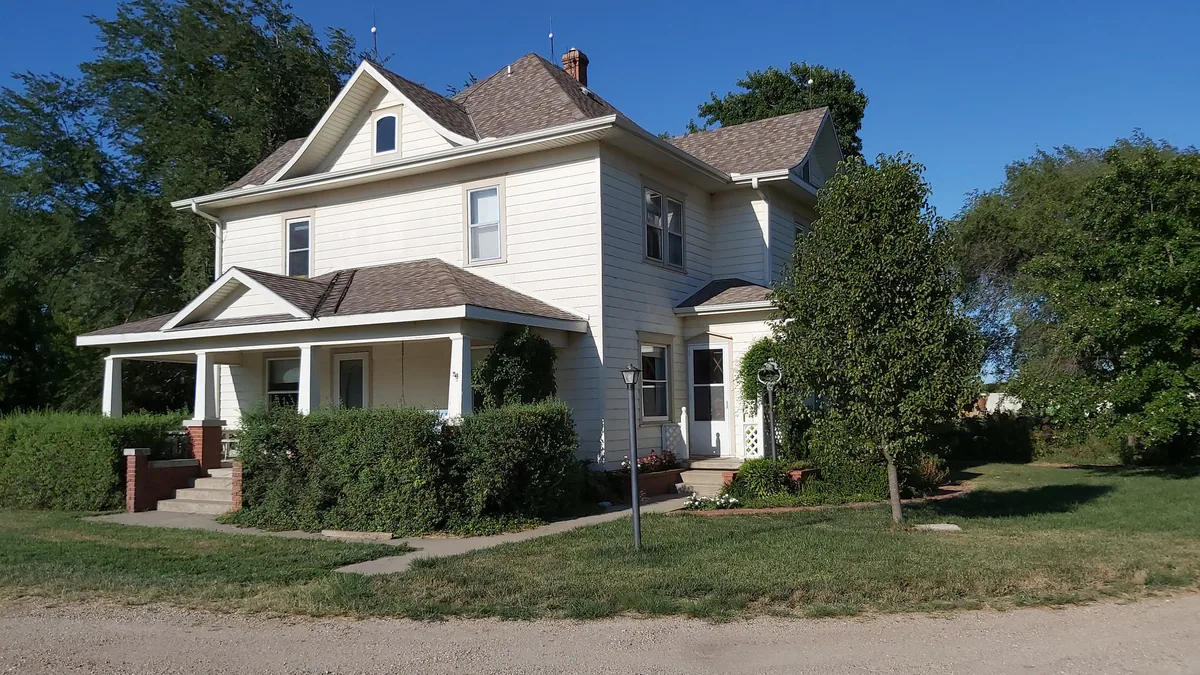
Gustav A. Harder—known as G.A.—built the house at the center of the Harder Farms operation. He and his wife Anna had 12 children, six boys and six girls. Gerhard was born in that house, where all six boys shared one bedroom.
Gustav was remembered as a hardworking farmer, a cheerful giver, and a father committed to the spiritual and material well-being of his children.
1921–2019
Gerhard Harder
Gerhard inherited the farm and farmhouse from his father, Gustav. A lifelong Kansas farmer and stockman, he married Anna Louise Regier in 1945, and together they had six children. He was a devoted Christian and member of Emmaus Church who enjoyed singing and reading.
Gerhard cared deeply about missions and traveled overseas nearly 20 times to visit family members and missionaries. He died in 2019 at age 98, survived by his wife, children, grandchildren, and great-grandchildren.
1907 to the present
The Farm Continues
Harder Farms dates its beginning to 1907. Richard Harder later took over the family farm from his father Gerhard. Richard and his wife Glenda had four children. Their son Chris was set to inherit the farm but died in a farming accident.
Chris’s brother Dave Harder and cousin Alan Braun have since taken over the farm’s operations. The names, equipment, and day-to-day work have changed, but the family’s Christian faith and responsibility to the land, livestock, and people around the farm remain central.
Talk with the farm
Questions about the farm or its history?
Call or send a message. The family is glad to continue the conversation.